Everyone loves the idea of the wild outlaw life, riding through dusty towns, breaking rules, and living free. But behind the legend of guns, gold, and glory was a world of fear, hunger, and constant danger. The truth is, being an outlaw wasn’t cool, it was lonely, brutal, and short-lived. Let’s pull back the curtain on what life as a real outlaw was actually like.
A Bleak Start:
Imagine you are an outlaw. And for you, this is kinda unfortunate, you’re born in 1874. You were born into a piss smelling upstairs room of a saloon in a town so small that it doesn’t even have a name, just a sign that says, “Don’t stay too long.” And population minus one. Your mother was 14 and exhausted. Your father was a stranger with a gambling problem and vanished before your first tooth came in. You didn’t grow up with big dreams. You grew up on spilled whiskey, stale bread, and the knowledge that a rattlesnake could slither into your bed and kill you in a matter of seconds. By the time you can count to 10, you’ve already seen a man bleed out in the street over a poker hand after a good old classic western standoff.
Work and Wages:
School is a luxury. Maybe you learn to read from a Bible and an old newspaper. Maybe not. More likely, you learn numbers by gambling and the alphabet by forging signatures. If you were lucky enough to go to school, most of the time you’d drop out and be working full-time by the time you hit 12 or 14. Your family puts you to work young, hauling water, shoveling manure, or running errands for older criminals. You had to do this if you and your family wanted to survive to see the next week. See, jobs back then didn’t pay very much. A cowboy would make about $25 a month. Railroad workers were paid about $30. And you? Well, boys started working around the age of six or seven. And most of the time, it was for free, working for your family. There were no protections against child labor until the early 1900s. So it was legal and expected that kids worked from sunup till sundown to help their families survive.
The Slide to Crime:
You start stealing food before you even know it’s wrong. A loaf of bread here, a coin from a drunk man’s coat there. By age 10, you’ve probably been caught and beaten at least once. By 12, you’re riding with older boys who show you how to pick locks and steal women’s purses. You’re rewarded with maybe a swig of whiskey to numb the pain. As you grow up, you first try honest work briefly until you realize that fixing fences for $2 a week is somehow worse than being shot at.
So, you drift into the outlaw life, not because you wanted to, but because it’s the only job where you can write your own hours, kill your boss, and try to actually make some money so you don’t starve to death.
The Myth vs. The Money:
You heard the stories of the insane lives the outlaws before you were living. In fact, many of these famous outlaws were teenagers. Jesse James committed his first murder before he was 18. Billy the Kid reportedly killed his first man at 15 and was dead by 21. And some of these so-called gangs were barely more than groups of angry teens with guns and bad facial hair.
Robbery Reality:
You specifically became an outlaw to try and better your life and make more money. But actually, most robberies profited very little. Many stagecoach robberies got less than $100. And the infamous Northfield bank robbery by the James Younger gang was a total failure and left most of the gang dead or arrested. So congratulations. You quit hardworking labor for no money to be an outlaw who will probably die for no money.
Day-to-Day Survival:
Your outfit is not what it looks like in the movies. Instead, it’s a filthy patch together collection of whatever clothes you didn’t die in yesterday. Your boots are mismatched. Your coat smells like 20 days without a shower. Bo and the horse. And your hat has more bullet holes than your last hideout. You haven’t seen a toothbrush since you were a child. And your hygiene routine involves a splash of creek water and hoping no one notices your teeth are starting to fall out of your mouth.
Diet:
Every meal you’re lucky enough to eat is a game of chance. Sometimes you eat jerky so dry it could be used as roof tile. Sometimes it’s beans, canned if you’re lucky, spoiled if you’re not. One time, you found a half-eaten apple on the side of a wagon trail and considered it dessert. Another time you tried cooking a squirrel over a fire you made with a torn wanted poster of your own face.
The Whiskey Lifeline:
Food poisoning isn’t a risk, it’s a lifestyle. And when there’s no food, there’s always whiskey. It’s your breakfast, your dinner, and your sleeping aid. You once used it to clean a knife wound and then drank the rest of the bottle so you wouldn’t remember the screaming.
Life Expectancy and Harsh Justice:
Being alive back in the Wild West was no joke. The life expectancy of a normal person back then was about 35 to 40 years old. But if you managed to make it past 20, you had a good chance to make it to 50. But unfortunately for you, outlaws rarely lived past their 30s.
Brutal Justice:
Most of them died by shootouts or lynching, ambushed by bounty hunters, or turned into the sheriff by their own gang members. Stealing a horse was basically a death sentence. Many outlaws would be lynched or hanged for stealing a horse. Yeah. Not murder, not going over the speed limit with your horse. No, they would kill you for stealing a horse. I mean, back then, horses were basically Lambos.
The Environment:
The weather was absolutely brutal. Scorching summers and freezing winters could kill you if you didn’t prepare. And most people lived in poorly insulated shacks. Dust storms, tornadoes, floods, and droughts were common. Most towns were miles from help. So if your house burned down or your well dried up, you were just, well, I guess screwed. Snowstorm, I guess you’re freezing to death.
The Price of Thrill:
You became an outlaw because robbery sounded easy on paper. You ride up, point a gun, take the money, ride off, and be a legend. But in reality, it’s usually three exhausted men arguing about who forgot the dynamite, while a fourth guy throws up in a bush. You’ve robbed stage coaches with nothing inside but letters and goat cheese. You held up a bank only to find out it had moved locations a week prior. One time, you stopped a train, fought off two guards, and made it off with a locked chest full of stale bread.
Boredom and Connection:
The payoff is rarely worth the scars, but you keep doing it because it’s the only time you feel anything. That and because boredom in the Wild West is more dangerous than bullets. When you’re not robbing something, you’re sitting around a fire listening to one-eyed Billy describe in graphic detail how he lost the second eye he never had.
Women and Betrayal:
Being an outlaw meant you most likely weren’t getting married. Women are not your salvation. They’re distractions at best, nightmares at worst. Like I said, outlaws died extremely young, so it’s not like you had a ton of time to find one. If you somehow fall for a girl, she steals your money, your spare bullets, and your horse. All in that order. If your lady doesn’t steal, then she could decide to join you in your life of crime or turn you in to the police. One outlaw married his first cousin and had two children. Another one had his wife kidnapped by police as a way to get to him. So, uh, yeah, maybe don’t get yourself a girl.
Corrupt Law and Violent End:
Now, sheriffs might be worse than you. They’re often drunk, corrupt, or both. They’d shoot you for stealing a pie, but ignore a murder if the guy pays taxes. They don’t just kill outlaws. They erase them. Burn down their hideouts, interrogate their lovers, mail their ears to their mothers. You’ve been running from one for over a year now. He’s got a silver revolver and a dead stare. Sometimes you dream about him, standing over your grave and shooting you in the foot.
Miserable Rest:
You don’t sleep well. When you do, it’s usually on rocks, in mud, or under some wagon with a broken axle. One time, you woke up with a possum chewing on your toe. Another time, you woke up in a pine box because someone thought you were dead and tried to bury you. You once slept inside a dead horse to avoid a blizzard.
Gunfight Chaos:
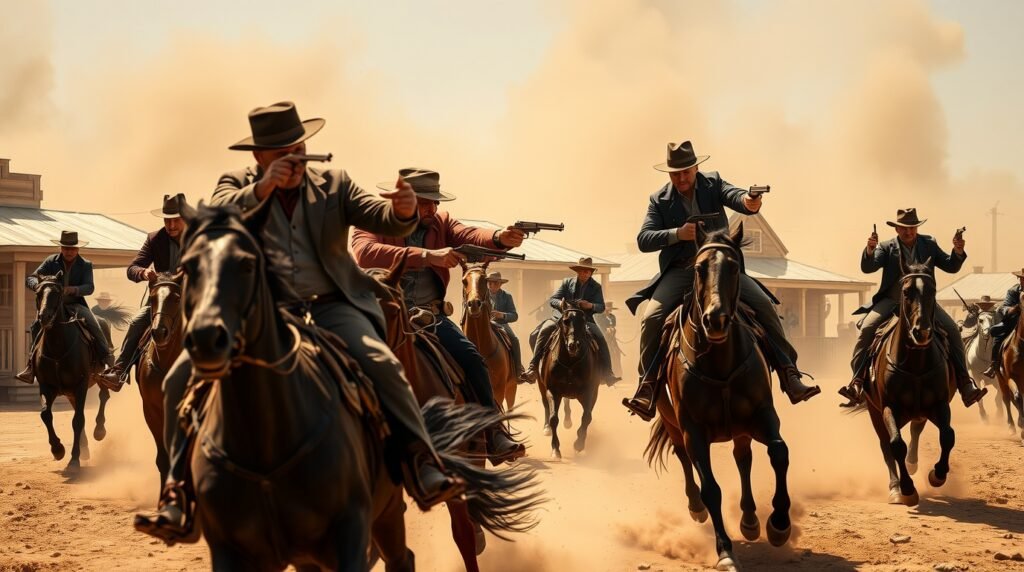
Gunfights are the most famous part of the Wild West, but these definitely weren’t how they look in the movies. They’re chaos. People miss at point-blank range. Guns jam, horses bolt, and someone always gets shot in the ass. You’ve been shot six times. One of them was from your own gang, accidentally, during an argument about who got the last piece of stale bread. You’ve dug bullets out of your flesh using a spoon, a rock, and once a sharpened spoon-shaped rock. Your left side is more metal than meat. But you keep firing because the only other option is getting shot in the ass again.
No Retirement:
There’s no retirement plan, no peaceful ranch, no future, just the fantasy of maybe getting rich enough to vanish. But even the ones who try end up in shallow graves under fake names. One guy you knew got out, opened a bakery in Kansas. 3 months later, a bounty hunter recognized his limp and shot him through the window. No one even got the muffin he was holding. You don’t think about tomorrow because it’s too painful. You think about breakfast, about bullets, and how many days you can stretch one can of beans. Hope is a luxury you buried two states ago.
By the time you’re an outlaw grandpa, your body is a collection of scars and failed surgeries. Your left leg clicks when you walk. Your shoulder aches whenever it rains. And your back hasn’t felt normal since you fell off a stolen horse during a thunderstorm in Nebraska. Doctors back then didn’t really know what they were doing. There were no anesthetics. They didn’t believe in germs. They were all about speed during surgeries instead of actually doing a good job.
Being an outlaw isn’t a legend. It’s a slow, sad life until one day you don’t see the ambush coming. One day, the bullets are faster. One day, the name you gave yourself dies in the dirt with you, forgotten, unmarked, and unloved. And even then, it still beat a long life of farming.
Conclusion:
The outlaw life might look exciting in movies, but the truth is far from glamorous. It was a world filled with pain, hunger, betrayal, and death. Most outlaws didn’t live long enough to become legends, and those who did were often remembered more for the chaos they caused than the freedom they chased. Behind every gunfight and wanted poster was just another person trying to survive in a world with no mercy. So next time you hear about a “cool” outlaw, remember, being one meant losing everything, including your life.
FAQs:
1. Were outlaws in the Wild West really heroes?
No, most were thieves, killers, or desperate people trying to survive. Their “hero” image came later from exaggerated stories and Hollywood movies.
2. How long did outlaws usually live?
Most outlaws died in their 20s or early 30s, often in gunfights, lynchings, or by betrayal from their own gang members.
3. Did outlaws actually make a lot of money?
Hardly. Many robberies brought in less than $100, and most outlaws stayed poor their entire lives.
4. Were all sheriffs and lawmen good?
Not at all. Many were corrupt, violent, or drunk. Some were just as dangerous as the criminals they hunted.
5. What was daily life like for an outlaw?
Dirty, hungry, and full of fear. Outlaws slept outdoors, ate rotten food, and were constantly on the run from bounty hunters.
6. Why do movies make outlaws look cool?
Because the legends sell better than the truth. Stories of rebellion and adventure sound exciting, but the real outlaw life was misery dressed up as freedom.