Ever heard something that makes perfect sense and zero sense at the same time? Welcome to the world of paradoxes, where logic takes a coffee break and your brain does backflips trying to keep up. From time loops to impossible truths, these mind-bending riddles of reality will make you question everything you thought you knew.
The Sorites Paradox:
So, let’s say you’re standing in front of your bathroom mirror one morning doing the usual routine, brushing your teeth, looking at yourself, wondering where it all went wrong, and then you notice it. A single hair fell out. Okay, no big deal. You’ve got thousands more. Still, a thought hits you. If one hair falling out doesn’t make you bald, and two hairs falling out doesn’t make you bald, then at what exact point does baldness officially begin? Is it after 100 hairs, 500, 5,000? At what number do you officially cross the line from guy with a bad haircut to guy who just went bald?
Because here’s the paradox. No single hair seems like the dealbreaker. But if you keep following that logic, you’d have to say that even a man with zero hairs on his head technically isn’t bald, which makes no sense. He’s definitely bald. Unless you’re Bruce Willis, in which case bald is just your final evolution. This is called the Sorites paradox, and it shows how fuzzy language can screw with logic. Bald isn’t a precise scientific measurement. It’s just a vague word we all kind of feel our way through. Which means, depending on who you ask, you might already be bald. Yeah, sorry about that. Let me know in the comments how many hairs on your head you have left until you are classified as bald.
The Time Travel Paradox:
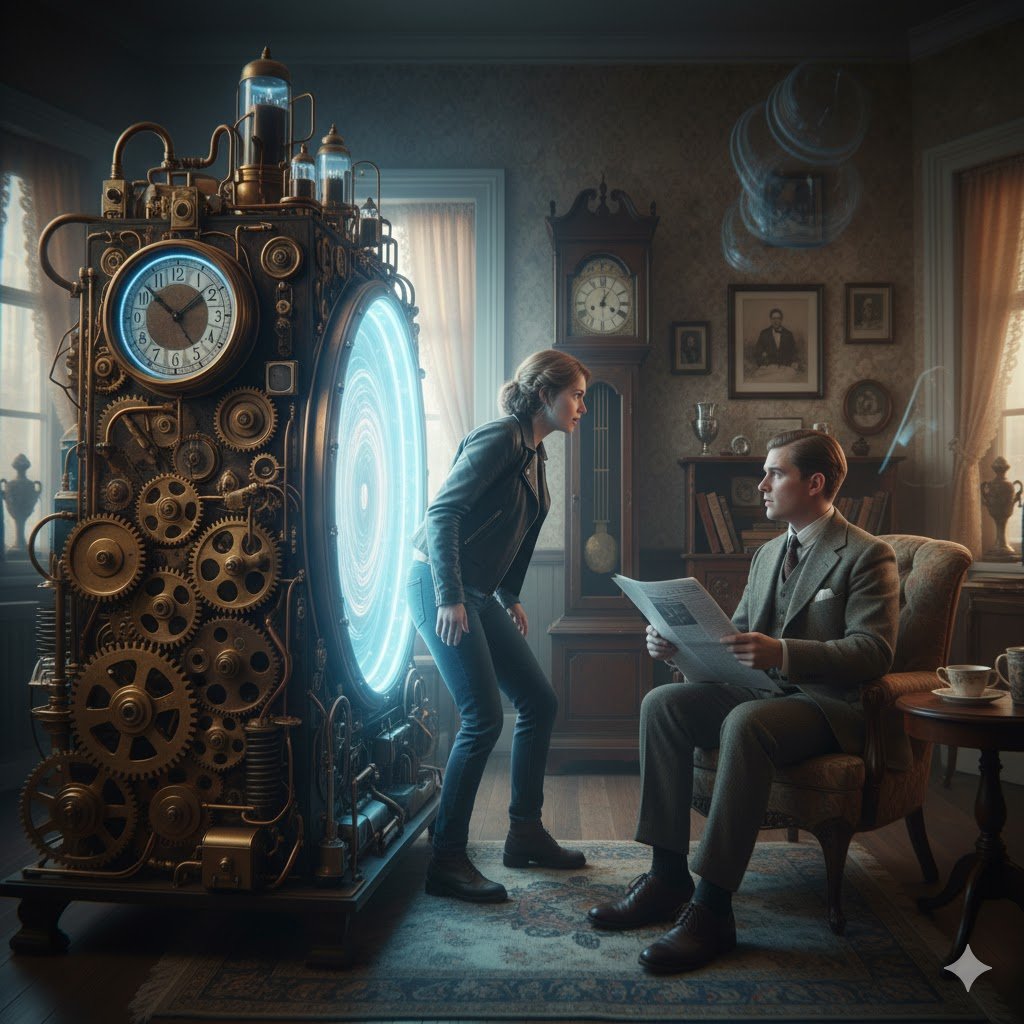
The time travel paradox. All right, let’s fire up the flux capacitor and talk about time travel for a second. Imagine you build a time machine. Not some crazy gadget. Yours looks like a busted washing machine duct taped to a lawn mower. But somehow it works. You set the dial for 1920 and poof, you’re face-to-face with your grandfather before he ever had kids. Now, for reasons best left unexplored, maybe he gave you terrible Christmas gifts. Maybe you just don’t vibe with him. You decide to uh take him out of the picture. Nothing personal, grandpa, but you’ve been paradoxed.
Here’s the problem. If you succeeded, then your grandfather never had kids, which means your parents were never born, which means you were never born, which means you couldn’t have gone back in time to do the deed in the first place, which means your grandfather is alive again. It’s like a cosmic game of peekaboo where existence just glitches out. The paradox shows that time travel to the past breaks causality, which is the chain of cause and effect that reality is built on.
Unless, of course, the multiverse exists. In that case, you didn’t erase yourself. You just spawned a whole new universe where you’re a monster and Grandma is single forever. Either way, if you’re planning on traveling back in time, maybe just shake your grandfather’s hand and thank him for surviving the Great Depression. Don’t, you know, erase your own family tree.
The Barber Paradox:
Picture this. You roll into a tiny one-road town in the middle of nowhere. The population is probably like 43 people and a few wild animals. And in this town, there’s exactly one barber. He’s not just a barber. He’s the barber. He cuts every man’s hair, trims every beard, and shaves every face.
But here’s the deal. This barber has one very strict rule. He shaves all the men who do not shave themselves, and only those men. So, if you’re too lazy to shave, no problem. He’ll do it for you. If you’re the kind of guy who gets up at 5:00 a.m. and shaves himself clean, cool. You don’t need him.
Simple, right? Except who shaves the barber? If the barber shaves himself, then according to his rule, he shouldn’t be shaving himself because he only shaves men who don’t shave himself. But if he doesn’t shave himself, then he falls into the group of men who must be shaved by the barber, which awkwardly is also him. No matter what he does, the rule breaks down.
Basically, the barber is cursed to live in a paradox where he either shaves himself illegally or he doesn’t shave and still has to shave himself anyway. He’s stuck in an endless cycle. Philosopher Bertrand Russell came up with this paradox to show how self-reference can completely derail logic.
So, moral of the story, don’t live in a town where the barber is both the hero and the villain.
The Unexpected Exam Paradox:
All right, let’s go to school for this one. You’re sitting in class, half asleep, doodling pictures of stickmen getting eaten by dinosaurs, when your teacher suddenly says, “There will be a surprise exam next week. You won’t know which day until I hand it out.” At first, everyone panics, but then you start thinking. You’re like, “Wait a second. This exam can’t actually happen.” You start breaking it down with some flawless logic.
First, you eliminate Friday because if Thursday rolls around and you haven’t had the test yet, then obviously it’s got to be Friday. But that means it wouldn’t be a surprise. So, it can’t be Friday. Okay, cool. But if it can’t be Friday, then it also can’t be Thursday, because if it hasn’t happened by Wednesday, Thursday would be the last possible day left.
So, it also wouldn’t be a surprise. And using the same logic, you eliminate Wednesday, Tuesday, and finally even Monday. You smugly sit back like some kind of wish Sherlock Holmes and announce to your classmates, There will be no exam at all.
Fast forward to Tuesday. You walk into class without your backpack, without a pencil, just vibes. And then, damn, the teacher slams a test down on your desk. You’re caught completely off guard. Congratulations, you just failed the world’s easiest paradox. This is the unexpected exam paradox, and it’s basically a logic trap. If you try to outsmart the surprise, you reason yourself into believing the exam is impossible. But the very fact that you don’t expect it anymore makes it possible again. Sometimes, overthinking just cooks you.
The Liar’s Paradox:
Imagine you’re at aparty and, for some reason, instead oftalking to normal people, you decide tocorner everyone with logic puzzles. Youstand up on a chair, raise your red solocup like a king, and announce, “I amlying right now.” At first, people juststare at you. Then the headache sets in.Because if the statement I am lying istrue, then you’re lying, which means thestatement isn’t true. But if it’s false,then you’re telling the truth, whichmeans it’s true again.
You’re stuck in aperfect loop of brain static where thewords cancel themselves out and everyoneat the party suddenly regrets invitingyou. This is the liar’s paradox, and it’sone of the oldest logic breakers inhistory. It goes all the way back toancient Greece, where a philosophernamed Epimenities, who fun fact, washimself a declared, “All cretins are liars,” which immediately raises thequestion, if he’s telling the truth,then he must be lying. But if he’slying, then some cretins must be tellingthe truth.
And if you’re not lost yet,congratulations, you’re lying toyourself. So if you’re ever tempted tobust this one out at a party, justremember, it doesn’t make you look likea genius. It just makes everyone elsequietly move away from you.
The Indescribable Paradox:
The word indescribable was created so that nothing can be truly indescribable. Think about that one for a moment. The moment you call something indescribable, you’ve literally just described it. If it truly couldn’t be described, you wouldn’t be able to slap a label on it in the first place. So, either the thing isn’t actually indescribable, or the word itself is lying.
The Monty Hall Paradox:

All right, let’s play a game. You’re on a cheesy ‘7s game show, standing under hot studio lights while wearing a suit. The host, Monty Hall, greets you with a big smile and points to three doors. Behind one door, a brand new car. Behind the other two, goats. You pick a door, let’s say door number 1. Monty, who knows what’s behind all of them, opens another door, say door number 3, and reveals a goat. Then he looks at you with his big game show grin and says, “Do you want to stick with your door or switch to the other one?” Now, here’s where the paradox kicks in.
Most people say it doesn’t matter. Two doors left, one car, one goat. It’s 50/50, right? Wrong. Switching actually doubles your odds of winning the car. If you stick with your first choice, you only have a one in three chance. But if you switch, you’ve got a two in three chance.
Why? Because when you first picked, there was a one in three shot you chose the car and a two in three shot you chose a goat. Monty’s reveal doesn’t reset those odds. It just hands you extra information. If you picked a goat originally, which is twice as likely, switching saves you. If you picked the car, switching loses it.
The math says switching wins in the long run. And yet, even when people are told the math, most still stay with their gut choice. That’s the real paradox. Human brains hate probability. We’d rather cling to our first bad decision than trust logic, which, come to think of it, explains dating, stock trading, and nearly all tattoos.
The Birthday Paradox:
Okay, here’s one that always blows people’s minds. The birthday paradox. You’re in a room with 23 people. Pretty small, right? That’s not even a full classroom. But get this. There’s a 50% chance that two of those people share the exact same birth. Now, your gut immediately screams, “No way.” After all, there are 365 days in a year. 366 if you’re one of those rare leap day mutants.
So, how could such a tiny group of people have matching birthdays? But that’s where probability tricks us. See, you’re not just comparing each person to one specific date. You’re comparing every person to every other person in the world with 23 people. There are 253 possible pairings. That’s 253 chances for a match. It’s like flipping a coin. If you only flip once, odds are slim. It lands on heads. But flip it a few hundred times, and suddenly it’s basically guaranteed. And the numbers get crazier. With 30 people, the odds jump to around 70%. With 50 people, it’s a 97% chance someone shares a birthday.
By the time you hit 75 people, it’s almost certain. Which means if you’re ever at a wedding and the DJ says, “Who here has the same birthday?” Odds are that at least two drunk dudes are about to high-five. This paradox works because our brains are absolute garbage at understanding probability. We think in terms of one-on-one comparisons, when in reality, the odds explode once you scale up the combinations. That’s why casinos exist and why math teachers cry themselves to sleep at night.
The Shuffling Paradox:
All right, grab a deck of cards. Go ahead. I’ll wait. Now, shuffle it. Congrats. You’ve probably just created something that has never existed before in the history of the universe. Sounds dramatic, but here’s the math. There are 52 cards in a deck. And the number of possible ways to arrange them is 52 factorial. That’s every number between 52 and 1 multiplied by each other. Do the math and you’ll get an 8 followed by 67 zeros. To put that in perspective, that’s more possible shuffles than there are atoms in our entire galaxy.
So every time you shuffle a deck, odds are astronomically high that the exact order of cards in your hand has never existed before in the history of the universe. Not in Vegas, not in Monte Carlo, not in your family poker nights, never. And the kicker, it will never exist again either.
You just created a unique cosmic arrangement. This is the shuffling paradox. Something as simple and ordinary as mixing a deck of cards is actually one of the rarest, most unique events you will ever cause. You think you’re just killing time, but mathematically speaking, you just did something that will never happen again in all of.
Conclusion:
So, after all that brain-bending madness, one thing’s clear: the universe doesn’t always play by our rules. Paradoxes remind us that logic, language, and even math have their limits. They force us to question what we think makes sense, and that’s what makes them so fascinating. Whether it’s a liar calling himself honest, a barber stuck in an impossible loop, or time travel tearing causality apart, these puzzles show how fragile our understanding of reality can be. So next time your brain feels twisted, don’t fight it, that’s the fun part.
FAQs:
1. What is a paradox in simple terms?
A paradox is a statement or situation that seems true but leads to a contradiction or doesn’t make logical sense.
2. Why do paradoxes matter?
They challenge how we think about truth, logic, and reality. Philosophers and scientists use them to test the limits of reason and language.
3. Can paradoxes ever be solved?
Some can be explained or redefined, but others remain unsolved because they expose flaws in how we understand logic itself.
4. What’s the most famous paradox?
The “Liar’s Paradox” (“I’m lying right now”) is one of the oldest and most famous because it directly contradicts itself.
5. Are paradoxes just word tricks?
Not always. Some are based on language, but others come from real science and math, like the Time Travel Paradox or the Monty Hall Paradox.
6. Why do people love paradoxes?
Because they mess with your head in the best way possible. They make you question everything, laugh at logic, and realize that even simple ideas can hide infinite complexity.