Remember when apps were actually free? Not free with an asterisk? Not free for the first 3 months, just free. Back in the early 2010s, you could learn a language without watching commercials. You could listen to music without ads every two songs. You could play games without being constantly interrupted. It felt like the golden age of technology. Apps were tools that worked for you. And then something shifted slowly at first, then all at once. The apps you loved started showing you ads, then more ads, then so many ads that using the app became miserable. Today, over 900 million people worldwide use ad blockers. Not because they hate advertising. No, no, because apps deliberately made the experience so unbearable that paying money to escape became the only option. This is a story of how the world’s most popular apps went from beloved tools to advertising weapons.
Duolingo: Educational Ransom:
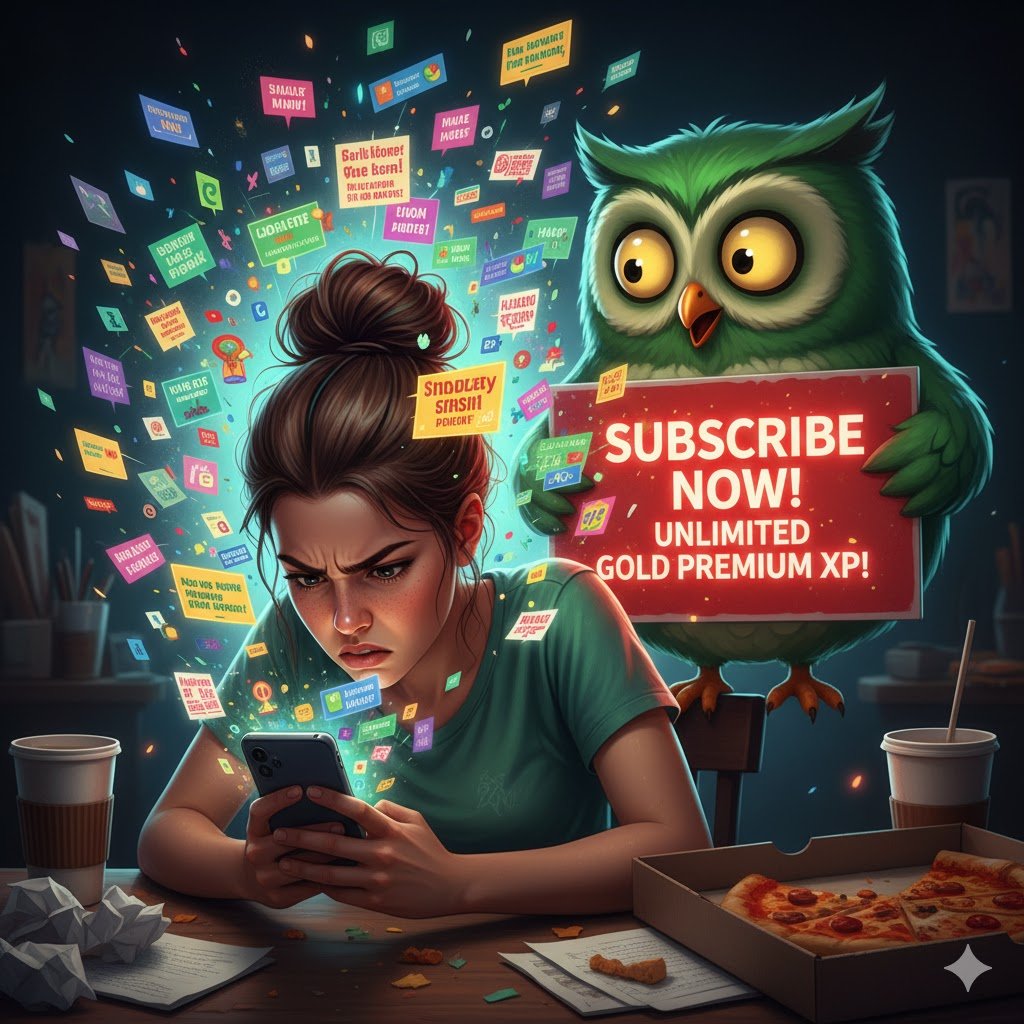
Let’s start with Duolingo, the app that promised free education for everyone. When Duolingo launched, it had a mission statement. Free language education for the world. And for a while, it actually delivered. You could learn Spanish, French, German, whatever you wanted, completely free. There were ads, sure, but they were occasional, manageable. The app exploded in popularity. Millions of people used it daily. Students, professionals, and retirees learning languages for travel. Duolingo became synonymous with accessible education.
And then the ads started multiplying. By 2022, Duolingo introduced something brutal. An ad after every single lesson. Not every few lessons, every single lesson. The Central Investigation class did the math. The complete French course has 1,26 lessons. That means 1,26 ads, each lasting 5 to 30 seconds. The total is up to 10 hours of watching advertisements to complete a 46-hour course. Yikes. Think about that. You’re trying to learn a language, and they’re forcing you to watch 10 hours of ads. That’s increasing the course length by 22% purely for monetization.
Reddit threads exploded with users asking, “Am I the only one getting a Super Duolingo ad after each lesson? Hundreds responded that they’d memorized the ad copy word-for-word after seeing it so many times. Many admitted they finally caved and subscribed just to make the interruptions stop, which was exactly Duolingo’s strategy. But it gets worse. Duolingo started pay-walling educational features that had been free.
The explain my answer feature, which showed grammar rules and explained your mistakes, became premium only. One user protested, “Explaining why you are wrong and being able to look at grammar rules seems like a fundamental thing to learning a new language, but Duolingo didn’t care. If you wanted to actually understand your mistakes, you had to pay. At almost $13 a month or $84 a year, Super Duolingo positioned itself as educational ransom. Pay to actually learn or suffer through enough advertising to negate any educational benefit.”
The gamification that once made Duolingo engaging, streak counters, leaderboards, and achievement systems became psychological leverage for monetization. Users reported deleting the app MISTREAK despite a significant time investment. Unable to tolerate the advertising assault any longer.
Duolingo’s mission statement promised free and fun education. Users suggested changing it to pay or ads. The app that was supposed to democratize education became just another subscription service holding your learning hostage.
Spotify: The Psychological Pressure Model:
Next up, Spotify. The app that promised to give you all the music you wanted. Spotify launched in the world in July 2011 with a simple deal. 6 months free with ads, then ads every four to seven songs after your trial expires. For most people, that felt reasonable. You could listen to music with occasional interruptions.
But by the 2020s, something changed. Users now report ads every two songs. And not just one ad, three to six consecutive 30-second ads playing back to back. You finish a song, and suddenly you’re listening to 90 seconds of commercials before the next track starts. One user posted, “Within the last few months, I’ve been getting more ads than songs. Every two songs, I get almost always three ads.” Another described hearing the same ad about 50 times in an 8-hour workday, the same commercial 50 times in one day.
Spotify introduced a feature where you could watch a video ad for 30 minutes of ad-free listening, except it frequently doesn’t work. Users watch the video ad, and two songs later, more ads appear anyway. And then there’s a volume manipulation. Spotify plays ads significantly louder than music. You’re listening to a chill playlist at comfortable volume and suddenly an ad screams at you, jarring you into attention. They also ignore the dislike button. Users report marking ads as irrelevant dozens of times and still seeing the exact same commercials over and over. The system isn’t designed to improve your experience. It’s designed to break you.
Here’s why. Spotify generates 90% of revenue from premium subscriptions. They use ads primarily as psychological pressure to convert free users. 80% of premium subscribers started as frustrated free users who couldn’t take it anymore. As one user put it, it’s like they are pushing subscriptions by adding more and more ads.
That’s not paranoia. That’s literally the business model. Make free so miserable that $11 a month feels like a relief. Spotify doesn’t want you to enjoy the free, either. They want you desperate enough to pay.
Mobile Gaming: Endless Punishment and Deception:
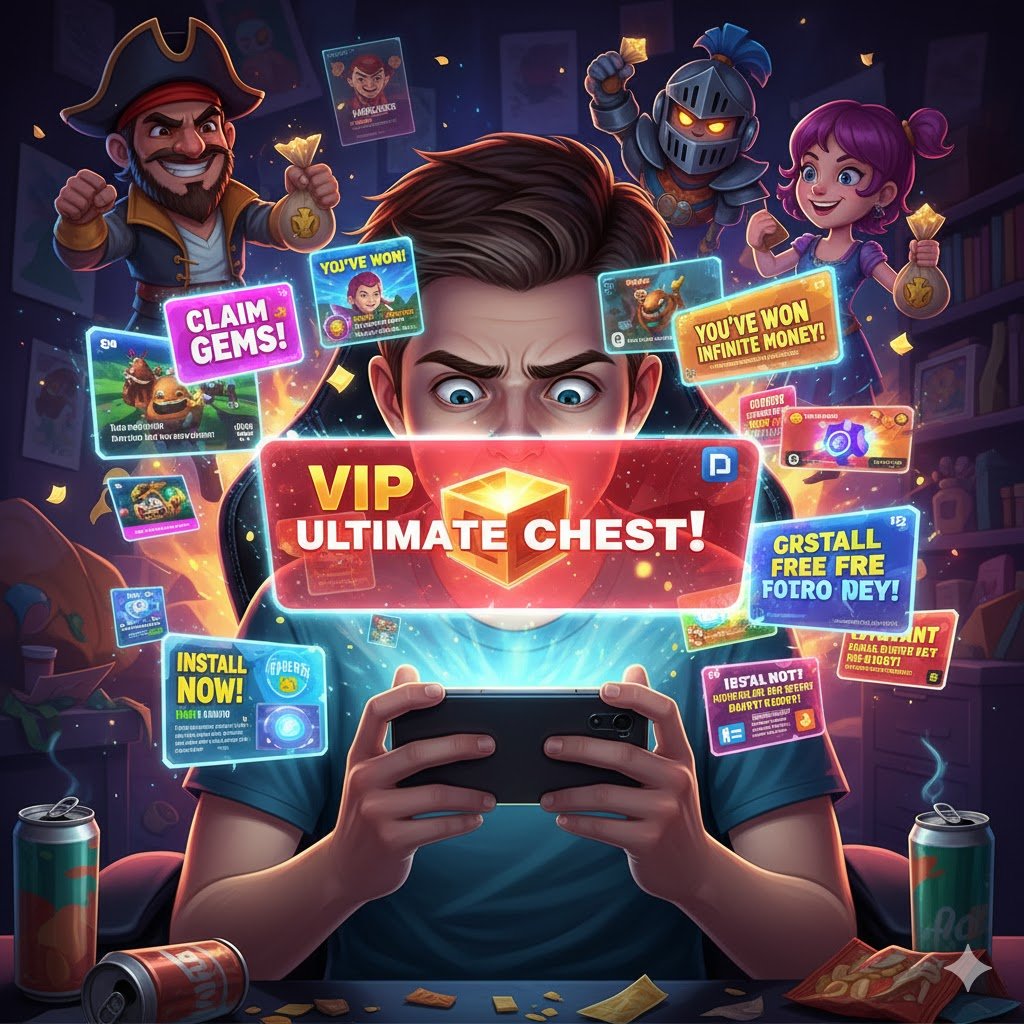
Okay, onto another one. Picture this. You’re playing a game on your phone. You fail a level. Ad. You want to continue? Watch an ad. You enter the main menu. Four pop-ups selling you coins, lives, power-ups, whatever. You close those banner ads at the bottom, covering the gameplay. You play for 2 minutes. Forced 30-second video ad. You can’t skip. This is mobile gaming in 2025, and it’s making developers $9 million a month.
But it wasn’t always like this. Go back to December 2009. Angry Birds cost $99. You pay once, you get 390 levels. No ads, no in-app purchases, no energy systems forcing you to wait. Just a complete game you own forever. That model made Angry Birds one of the most successful mobile games in history. Hundreds of millions in revenue from people who happily paid a dollar for a good game.
Then someone did the math. Free games with ads and microtransactions make 300 times more money than paid games. 300 times. So in 2013, they retrofitted the original Angry Birds. The game you’d paid for now has ads and microtransactions.
Then Angry Birds 2 launched in 2015 as a blueprint for misery. Live system. Wait 30 minutes or watch ads. Video ads after every failed attempt. Banner ads during gameplay block where your birds fly. Pop-ups every time you open the menu, etc., etc., etc. And here’s where it gets truly insane.
In 2019, Rovio deleted every original paid Angry Birds game from the app stores. The games people had bought just vanished, gone. Fans revolted. The hashtag #bringback 2012 trended globally. Rovio responded by briefly offering a paid remake, then deleted that too in 2023. The paid version made 30,000 a month. The Ad-filled version made 9 million, so they eliminated choice entirely. Everyone gets funneled into the ad hellscape. Words with Friends has a full-screen ad after every single turn.
Subway Surfers ads after every other game. Royal Match 75-second unskippable ads so common they became the most hated advertisement on the internet, and downloading Royal Match to make the ad stop doesn’t work. The ads for Royal Match keep appearing in other games anyway. But the ads themselves became the real scam.
Those pin-pulling puzzle games you see everywhere, the gameplay doesn’t exist. Home Escapes and Garden Escapes got banned in the UK for false advertising. The puzzles in their ads represented less than 1% of actual gameplay. You download expecting one game, you get a completely different match-three, requiring hours of grinding to reach anything resembling the ad.
A 2024 report found that 56% of mobile gamers encountered ads that completely lied about gameplay. Over half of apps get uninstalled within 30 days because users feel deceived. Mobile gaming went from pay once, own forever to free download, endless punishment.
Consumer Resistance: The Ad-Blocking Revolt:
The apps had pushed too far, and users were about to push back. Because here’s what happened next. People stopped accepting it. By 2023, 912 million people globally had installed ad-blocking software. That’s a 21 times increase since 2012. In the United States, 32% of all Americans now block ads. This isn’t just tech-savvy millennials. Baby boomers block ads at 32%. Actually, higher than Gen Z’s 27%. This is the largest coordinated consumer resistance movement in internet history.
And the reasons are damning. 63% site has too many ads. 53% say ads get in the way of content. Another 44% want to avoid tracking. The message is clear. Platforms crossed the line. The economic impact is staggering. Publishers lost 47 to 54 billion in ad revenue in 2023 alone. That’s 8% of total digital ad spending. Just gone. Users aren’t complaining; they’re actively sabotaging the business model. Trust in advertising collapsed to 37% in 2024.
Last place among all industries, below banking, below energy companies, when 70% of people report seeing the same ads repeatedly, and only 11% actually enjoy advertising. The system has fundamentally failed. YouTube launched an aggressive anti-AdBlocker campaign, threatening to limit viewers to three videos. It backfired spectacularly. Ad blocker searches spiked 336%. Users discovered workarounds within hours using the Brave browser, Firefox with Ublock Origin, playing multiple videos, and switching tabs. As one site puts it, YouTube might be powered by money, but ad-blocking developers are powered by spite.
Reddit’s 2023 API crisis showed organized user anger. When Reddit killed third-party apps to force users into their Ad-filled official app, communities revolted. Major subreddits went dark for 48 hours. Millions of users participated.
The Real Problem:
But here’s the problem. Most people can’t actually leave. Spotify has your playlists. Duolingo has your streak. Mobile games have your progress. These platforms built monopolies through habit and investment, then exploited that lock-in to make experiences miserable. They’re betting that most people will either tolerate the ads or eventually pay to escape. And so far, they’ve been mostly right. The apps didn’t die. They just became platforms that users hate but can’t quit.
Conclusion
So, what happened to the apps we loved? The same thing that happens to everything that gets too big, they stopped serving users and started serving shareholders. What began as a golden age of creativity and access slowly turned into an attention economy built on frustration, manipulation, and paywalls. The apps that once made life easier now charge us for relief from the very misery they created. But the rise of ad blockers, user revolts, and mass uninstallations shows one thing clearly: people are fighting back. Maybe, just maybe, the next evolution of tech will remember that the best way to make money isn’t to annoy users, it’s to earn their trust again.
FAQs:
1. Why did apps start showing so many ads?
Because ads became more profitable than offering one-time paid versions. Companies realized that constant interruptions drive users to pay for premium plans, turning frustration into revenue.
2. Which apps are the worst offenders?
Apps like Duolingo, Spotify, and most mobile games top the list. They’ve increased ad frequency and removed free features to push users toward subscriptions.
3. Are ad blockers actually legal?
Yes, ad blockers are legal in most countries. However, some platforms, like YouTube, are trying to block users who use them.
4. Why don’t companies just offer ad-free versions for a small one-time fee?
Because subscriptions generate far more money over time. A one-time $5 payment can’t compete with $10 a month from millions of users.
5. Does using ad blockers hurt creators?
Sometimes, yes. Ads fund free content and creators’ earnings. But when platforms abuse ads, users turn to blocking as self-defense. The real fix would be fairer ad practices.
6. Will the app experience ever get better again?
It might. As user backlash grows and alternative, privacy-friendly platforms gain traction, companies may be forced to rethink their strategies. Change will happen when users stop settling for misery in exchange for “free.”